Request A Call Back

How to Get Your Car Unstuck From Snow or Mud (And When to Stop Trying)
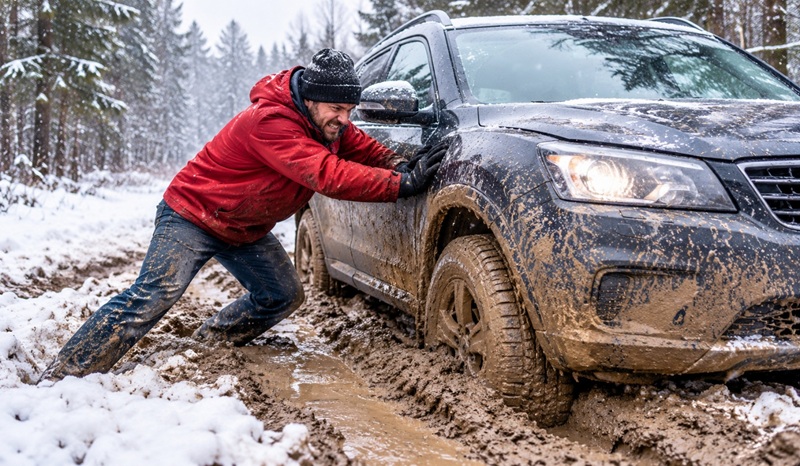
You press the gas, the engine roars, and your tires just spin. Whether it's a snowy driveway in Michigan or a muddy back road after a storm, getting stuck is frustrating. The good news: most cars can be freed in a few minutes with the right technique.
The bad news is that the wrong technique can dig you deeper, burn out your tires, or damage your transmission. This guide walks you through what works, what to avoid, and how to tell when it's time to stop trying.
1. Check That It's Safe Before You Try Anything
Before you touch the gas pedal, take 30 seconds to make sure you're not putting yourself in danger.
- Clear the exhaust pipe. If snow is packed around your tailpipe, carbon monoxide can build up inside the car while the engine runs. Clear it before you sit and idle.
- Turn on your hazard lights. This warns other drivers, especially if you're on or near a road.
- Look at where you are. If you're stuck on a busy shoulder, on a steep slope, or close to a ditch, don't try to rock the car out. Stay safe and get help instead.
- Check for damage. If you hit something on the way in (a curb, a rock, a frozen snowbank), look under the car for leaks before you start spinning the wheels.
2. Straighten Your Wheels and Clear Around the Tires
Turned wheels push against the snow or mud instead of rolling through it. Point your front wheels straight ahead so the car has the easiest path out.
Next, clear space around your drive wheels. That's the front wheels on most cars, the rear wheels on many trucks, and all four on AWD or 4WD vehicles.
- Dig out snow in front of and behind each tire, about 2 feet in both directions.
- Remove snow packed under the car. If the frame is resting on a snow pile, the tires can't grip no matter what you do.
- In mud, scrape away the thick mud building up in front of the tires so they don't have to climb a wall.
3. Use Gentle Throttle, Not Hard Acceleration
Flooring the gas is the most common mistake. Spinning tires polish snow into ice and dig deeper ruts in mud. Slow and steady gives your tires the best chance to grip.
- Use a low gear. Put an automatic in "L", "1" or "2", or use second gear in a manual. Lower gears deliver power more gently.
- Press the gas lightly. Ease on until you feel the tires grab, then hold steady.
- Consider turning off traction control. Traction control cuts engine power when it senses wheel spin. That's great on the road, but when you're stuck it can stop you from getting any momentum. Check your owner's manual, and turn it back on once you're free.
- Stop if the tires just spin. If nothing changes after a few seconds, ease off. More spinning only makes the hole deeper.
4. Try the Rocking Method
Rocking builds momentum by moving the car back and forth in its own tracks. Each swing packs the snow or mud a little flatter until the car can roll out.
- Drive forward gently until the tires start to slip.
- Ease off the gas and let the car roll back as far as it will go.
- Once the car has stopped, shift into reverse and back up gently until the tires slip again.
- Repeat, moving a little farther each time.
- When you get enough momentum, keep going in that direction and don't stop until you reach solid ground.
Important: always let the car come to a full stop before you switch between drive and reverse. Shifting while the wheels are still moving puts heavy strain on an automatic transmission. If rocking doesn't work after 5 or 6 tries, stop and move on to the next step.
5. Add Traction Under Your Tires
If your tires can't grip, give them something to grip. Place the material directly in front of the drive wheels (or behind them if you're backing out), pressed in as close to the tire as possible.
| What to use | Works on | Tip |
|---|---|---|
| Traction mats or boards | Snow and mud | The best option. Keep a pair in your trunk all winter. |
| Sand | Snow and ice | Adds grip and weight. A small bag in the trunk also helps rear-wheel-drive cars. |
| Non-clumping cat litter | Snow and ice | Clumping litter turns to paste when wet, so pick the non-clumping kind. |
| Gravel or small rocks | Mud | Pack it into the ruts in front of the tires. |
| Branches, sticks or cardboard | Snow and mud | Good emergency option when you have nothing else. |
| Car floor mats | Snow | Use rubber mats, upside down. They can be shredded or thrown out by the tire, so stand clear. |
Once the traction material is in place, use the same gentle throttle from step 3. Never stand behind or beside a spinning tire, because it can throw mats, rocks or ice with real force.
6. Let a Little Air Out of the Tires (Last Resort)
Slightly lower tire pressure makes the tire's footprint wider, which can add grip in deep snow or soft mud. Off-roaders use this trick often, but it comes with risks for everyday drivers.
- Only let out a small amount, a few PSI from each drive tire. Never go so low that the tire looks flat.
- Drive slowly and gently once you're free. Underinflated tires handle poorly and can come off the rim in sharp turns.
- Re-inflate to the pressure on your driver's door sticker as soon as possible, at the nearest gas station or with a portable air compressor.
If you don't have a way to refill the tires nearby, skip this step.
7. Snow vs. Mud: What's Different
The basic steps are the same, but snow and mud behave differently under your tires.
| Snow | Mud | |
|---|---|---|
| Why you're stuck | Tires polish snow into slick ice, or the car is sitting on packed snow | Tires sink and lose contact with firm ground |
| Best first move | Dig out around the tires and under the car | Clear mud from in front of the tires, then add gravel or boards |
| Does rocking help? | Usually yes | Sometimes, but it can sink the car deeper in soft mud |
| Biggest risk | Carbon monoxide from a blocked exhaust | Sinking to the axle, which usually needs a winch |
| When to stop | Tires only spin on ice after several tries | The car is sinking lower with each attempt |
In deep mud, the car can settle further with every try. If you notice the body getting closer to the ground, stop. A car buried to the axles almost always needs a winch to come out safely.
8. Mistakes That Can Damage Your Car
Getting unstuck is not worth an expensive repair bill. Avoid these common mistakes:
- Spinning the tires at high speed. This can overheat the tires and, in extreme cases, cause them to fail. It also overheats the transmission and differential.
- Shifting while the wheels are moving. Rocking is fine, but always stop fully before switching from drive to reverse.
- Pulling with a random rope or chain. Ropes and chains not rated for recovery can snap and whip back with dangerous force. Hooking to the wrong part of the car can also bend the bumper or suspension.
- Letting a stranger tow you with their truck. Without proper recovery points and gear, both vehicles can be damaged.
- Pushing from behind a spinning tire. Anyone pushing should stand to the side of the car's body, never in line with the tires.
- Running the engine with a blocked exhaust. Keep checking the tailpipe if snow keeps falling.
9. When to Stop and Call for Help
Knowing when to quit is just as important as knowing what to try. Stop and call a professional if:
- You've been trying for more than 15 minutes with no progress.
- The car is sliding sideways toward a ditch, another car or a pole.
- You're stuck on a slope or hill.
- The car has sunk to the axles in mud or snow.
- You smell burning rubber or a hot, burnt smell from the transmission.
- You're on a busy road or highway shoulder where traffic is passing close by.
- It's dark, very cold, or a storm is getting worse.
In these situations, it's safer and usually cheaper to book a snow and mud recovery service than to risk damaging your car or getting hurt. A trained operator has a winch, recovery straps and the right tow points to pull your car out without damage.
While you wait, stay in your car if it's safe, keep the exhaust clear, and run the engine only in short bursts for heat.
10. Winter Car Kit: What to Keep in Your Trunk
The best way to handle getting stuck is to be ready before it happens. Keep these items in your car from November through March:
- Compact snow shovel
- Traction mats or boards
- Bag of sand or non-clumping cat litter
- Ice scraper and snow brush
- Portable air compressor
- Jump starter or jumper cables (see our guide on portable jump starter vs jumper cables)
- Flashlight with extra batteries
- Warm blanket, gloves and a hat
- Phone charger or power bank
- Water and a few snacks
Frequently Asked Questions
Does 4WD or AWD help me get unstuck?
It helps because power goes to all four wheels, so more tires are trying to grip. But it won't help much if the car is sitting on packed snow or sunk deep in mud. The same steps above still apply.
Should I turn off traction control when stuck?
Often, yes. Traction control cuts power when wheels spin, which can stop you from building momentum. Turn it off only while you're getting unstuck, then turn it back on.
Can I use my floor mats for traction?
Yes, rubber mats placed upside down can work in snow. Expect them to get damaged, and stand clear because the tire can throw them.
Is it bad to spin my tires in snow?
A little spinning is normal. Long, high-speed spinning polishes the snow into ice, digs you deeper and can overheat your tires and transmission.
How do I get my car out of mud without another car?
Clear the mud in front of your tires, add gravel, boards or branches for grip, and use gentle throttle in a low gear. If the car is sunk to the axles, you'll likely need a winch.
Final Thoughts
Most drivers can get unstuck from snow or mud with patience, gentle throttle and a little extra traction. Clear the exhaust, straighten your wheels, dig out your tires and rock the car slowly. Never risk your safety or your car for a few more minutes of spinning.